

I built Gander as a personal project to explore how AI could become part of my everyday development workflow. The game gives players an AI-generated image and six chances to identify the adjective, verb, and noun behind it, with feedback helping them narrow down their guesses.
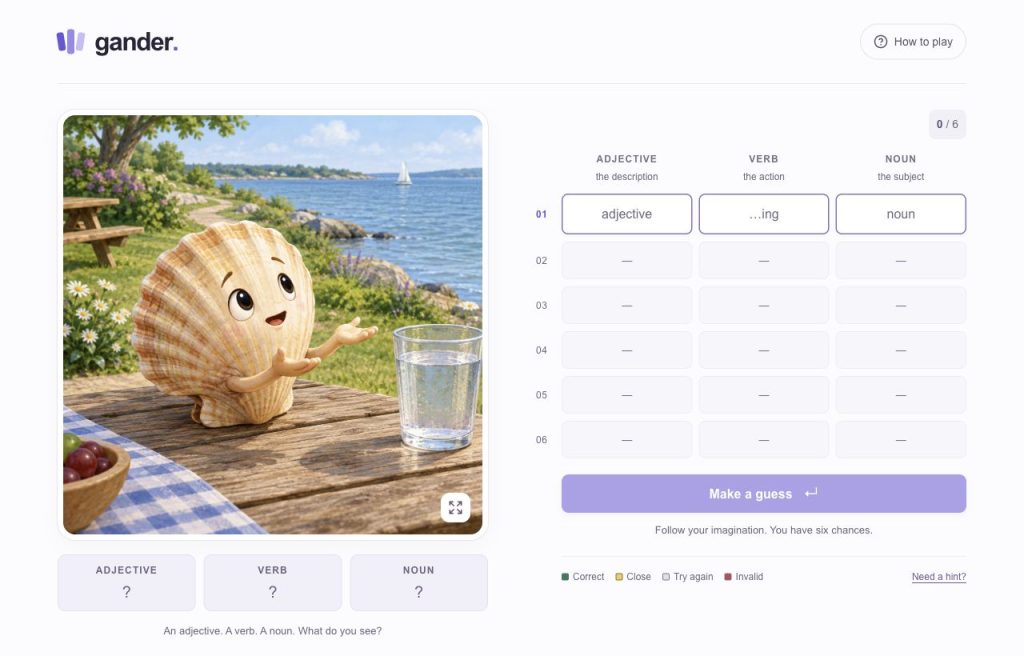
My central focus was using AI throughout development, from an initial prototype through implementation, testing, debugging, and deployment. I defined the game’s requirements, evaluated the results, and directed revisions as the project developed. This gave me a practical opportunity to work with a coding agent on a complete application.
Play testing was an important part of that process. Early versions sometimes rejected valid words or accepted words in the wrong grammatical category. I identified these issues through gameplay and worked with Codex to improve validation, feedback, and puzzle difficulty. I also refined the interface, added hints, and introduced result sharing that wouldn’t spoil the answer for other players.
Beyond the gameplay, I specified requirements for keeping answers on the server, saving daily progress, and supporting mobile devices. The application uses Next.js, React, and TypeScript and is deployed on Vercel, with scheduled puzzle generation through the OpenAI API.
Gander gave me hands-on experience translating product ideas into clear instructions for AI tools, evaluating generated functionality, and guiding successive improvements through to a live release. It’s a working example of how I’m bringing AI into my development process while maintaining responsibility for the product’s direction and quality.