
From February 2024 to April 2026, I worked as Senior Web Developer at APS Marketing Group, reporting directly to the CEO. I managed a distributed team of four developers and coordinated technical delivery across four to five concurrent client projects.
My responsibilities included technical decisions, project planning, developer feedback, reviewing deliverables, and resolving blockers. I also worked directly with clients to understand their feedback and translate it into implementation tasks. Design and copy were handled by other departments.
A major part of my work was establishing a consistent development process. That included standardizing our WordPress stack, moving websites to managed hosting, introducing structured project management through Monday.com, and developing integrations where clients needed functionality beyond our standard configuration.
The results included:
- Consolidating more than 80 MediLodge facility websites into one website in about a month.
- Making it possible to add a facility page within an hour, compared with the two to three weeks previously required to launch a separate facility website.
- Eliminating a recurring category of support requests that had generated approximately three to five tickets per day.
- Helping the team deliver Simply Grab Bars from design to launch in under a week.
These improvements came from changes to both our technical foundation and the way we organized the work.
Before standardization, individual developers made most implementation decisions independently. WordPress was widely used, but websites often relied on different plugins to accomplish similar tasks. Custom code had accumulated without a consistent review process.
This made maintenance unpredictable. A developer assigned to an existing website first had to understand its particular combination of plugins and custom implementations. Even small changes could require substantial investigation. Performance issues and technical debt added to that effort.
Standardizing development
I introduced a standard WordPress configuration built around Elementor for page layouts and forms, and Advanced Custom Fields for structured content and custom post types. We also standardized tools for email delivery, analytics, SEO metadata, backups, and spam filtering.
The goal was to give developers a familiar foundation for every project. Reusing established tools reduced repeated implementation work and made it easier to move between websites.
I moved our hosting to Cloudways, which provided a consistent environment for application management, backups, restoration, and staging. I also wrote an installation script to provision our standard plugins on new WordPress applications.
New client websites became the initial proving ground. I documented the approved configuration and established a review process for exceptions. Additional plugins and custom code required discussion and authorization, including consideration of security, maintenance, and whether an existing tool could meet the requirement.
As the approach proved useful, we continued using it for new projects and rebuilt existing websites where appropriate.
Staging became a central part of delivery. Before release, we tested websites and used Lighthouse and PageSpeed Insights to identify performance, accessibility, and technical SEO issues. Hosting-level monitoring and security checks provided additional oversight. When custom code was necessary, I reviewed it directly, including its security implications, and used AI-assisted review as an additional check.
The standard configuration reduced the amount of bespoke code requiring review while keeping testing and release review part of the process.
Managing concurrent projects
Managing several projects simultaneously also required a clearer view of priorities, ownership, and deadlines.
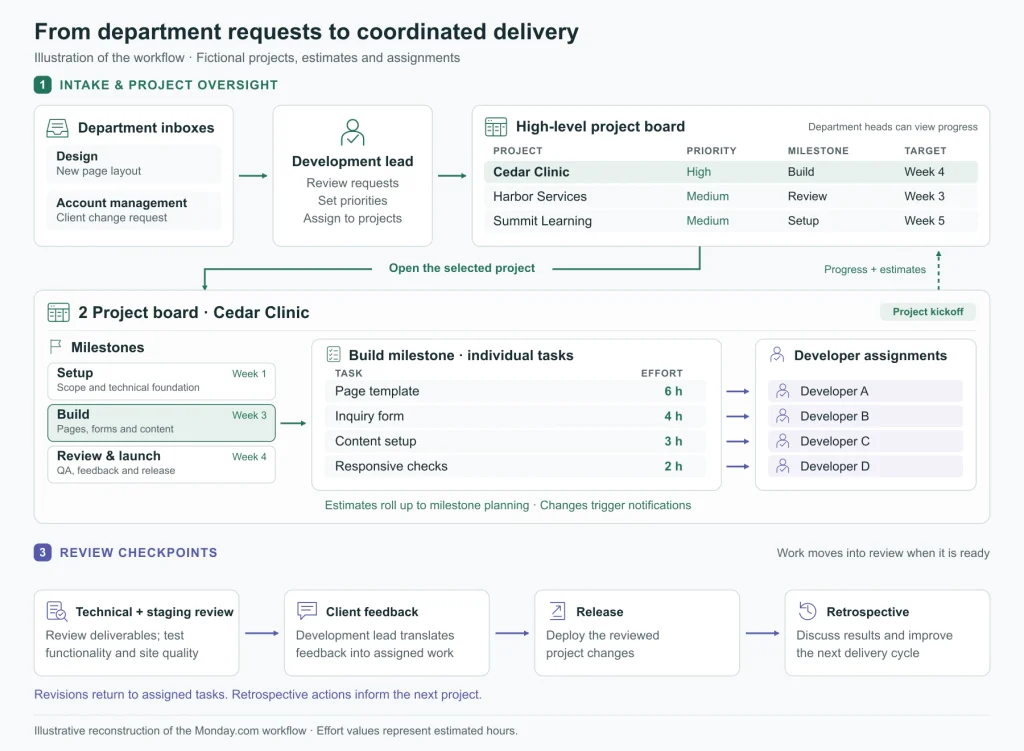
I organized Monday.com around a high-level project board containing priorities, milestones, and expected completion dates. Each project had a separate board shared with its assigned developers. Milestones were broken into specific tasks, with effort estimates based on expected hours.
This gave developers a prioritized view of their assignments and gave me a practical way to assess workload and delivery expectations. Templates reduced setup work, while automations kept information synchronized and notified us of changes. One automation totaled task estimates within a milestone and updated its expected completion date.
Designers and account managers could view the high-level boards to follow progress. Department inboxes allowed them to submit requests that I could assess and assign. Notifications helped me respond when changes elsewhere affected development priorities.
I introduced the workflow through a recorded training session, supported by a transcript the team could revisit. Adoption was smooth. We held project kickoffs and retrospectives to establish expectations, review results, and identify improvements.
The MediLodge rebuild brought these technical and organizational changes together.
Consolidating MediLodge
The existing implementation was a WordPress multisite network serving more than 80 facility websites. The sites shared substantial content and code, but updates still required work across individual websites. Years of inconsistent implementation had made the system difficult to maintain.
I led the technical effort to consolidate the network into a single website, launched in the first quarter of 2026.
Shared content moved to the main site. Each facility became an entry in a custom post type, with its individual information managed through ACF fields. Developers built pages and reusable templates in Elementor while I focused on content consolidation, backend development, and integrations.
Old URLs redirected to the corresponding facility pages. We tested contact routing in staging and introduced the client to the new workflows through meetings and documentation.
The consolidated site took about a month from kickoff to launch. Adding a facility became a structured publishing task that could be completed within an hour. Previously, launching a separate facility website could take two to three weeks.
Routine changes also became easier. Updates that had taken several days of investigation and implementation could often be completed within an hour.
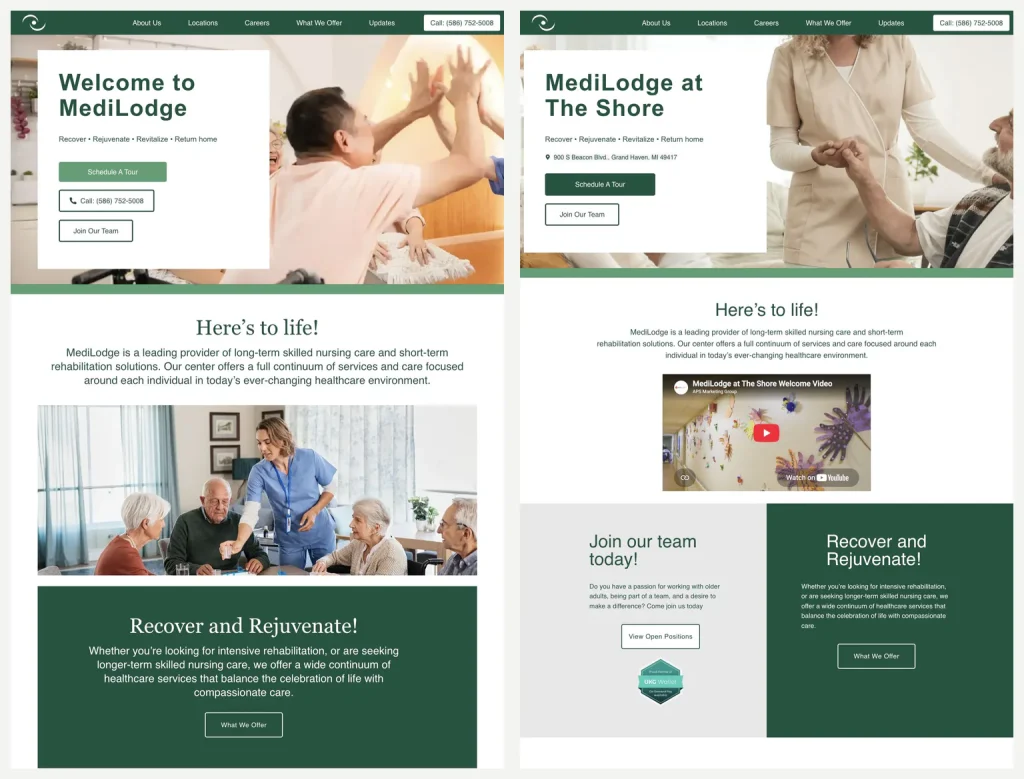
The current MediLodge website broadly reflects the system our team delivered.
One of the most useful improvements addressed a recurring support problem.
Automating contact routing
Each facility’s contact forms needed to reach specific employees. Previously, recipient information was managed through individual WordPress user accounts, even though those employees did not need dashboard access. Staff changes generated approximately three to five support tickets per day requesting mailing-list updates.
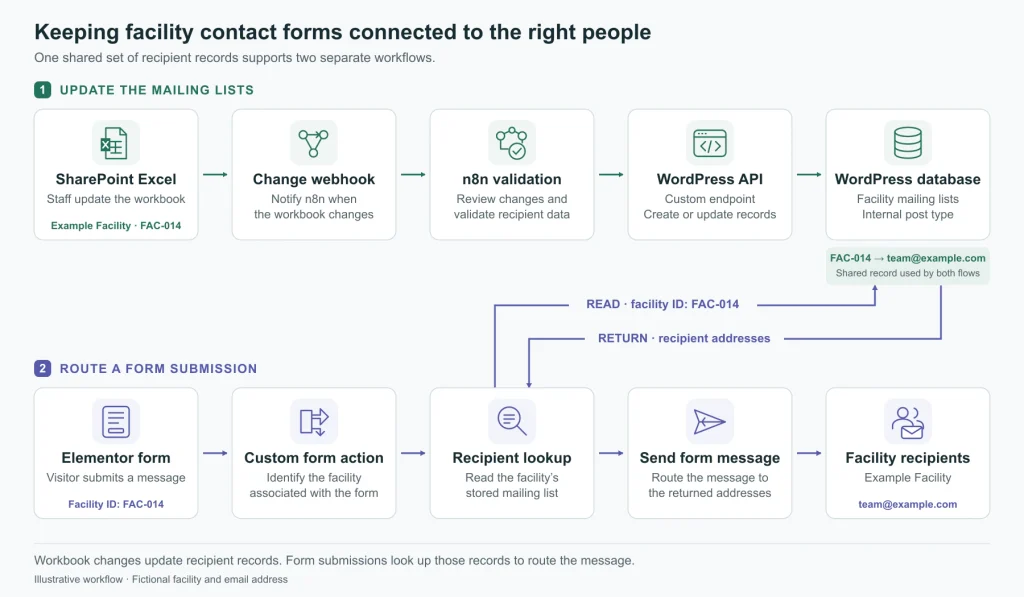
I developed an integration that allowed MediLodge to manage this information through an Excel workbook hosted in SharePoint.
When the workbook changed, a webhook notified n8n, an AI-powered automation tool. The automation reviewed and validated the changes, then sent applicable updates to a custom WordPress API endpoint I wrote. That endpoint created or updated records in an internal post type containing the mailing lists associated with each facility.
I also wrote a custom Elementor form action. When a visitor submitted a form, it identified the appropriate facility mailing list and routed the submission to its recipients.
Validation checks and notifications helped staff identify problems with their entries. The client could maintain recipient information using a familiar tool, without requesting routine changes through our support team.
After implementation, that recurring category of support tickets stopped entirely.
The project also required adapting to changing expectations.
After the consolidated site launched, the client requested a mobile Largest Contentful Paint target of one second or less while retaining large visual assets on the homepage.
I worked with the client to explain how those requirements affected each other and identify design adjustments that could support the performance target. I then translated the agreed changes into implementation work and redirected the team toward optimization. The resulting work met the client’s agreed benchmark.
This required coordination across client expectations, design decisions, and technical delivery. My responsibility was to make the tradeoffs understandable and give the team a clear path forward.
Simply Grab Bars provided another example of the standardized approach. It was one of the first websites built with the new configuration and the first full site the team delivered from design to launch in under a week.
The familiar tools and shared workflow gave developers a more predictable starting point. As we refined responsibilities, I delegated more routine backend administration and concentrated my development time on the custom functionality that required closer technical oversight.
Conclusion
My experience at APS reinforced the value of making routine work consistent. A shared technical foundation, clear project ownership, and visible priorities gave the team more room to focus on client requirements and difficult implementation decisions.
That is the approach I bring to technical leadership: establish practical standards, support the people doing the work, and evaluate improvements through their effect on delivery, maintainability, and the people using the resulting systems.
Delivery times and support volumes are approximate figures based on my experience managing these projects. The following are links to some of the work I did at APS Marketing Group:
APS Marketing Group, MediLodge, SimplyGrabBars, SKLD Care, BluePalms Senior Living, Stop the Talking in Schul!